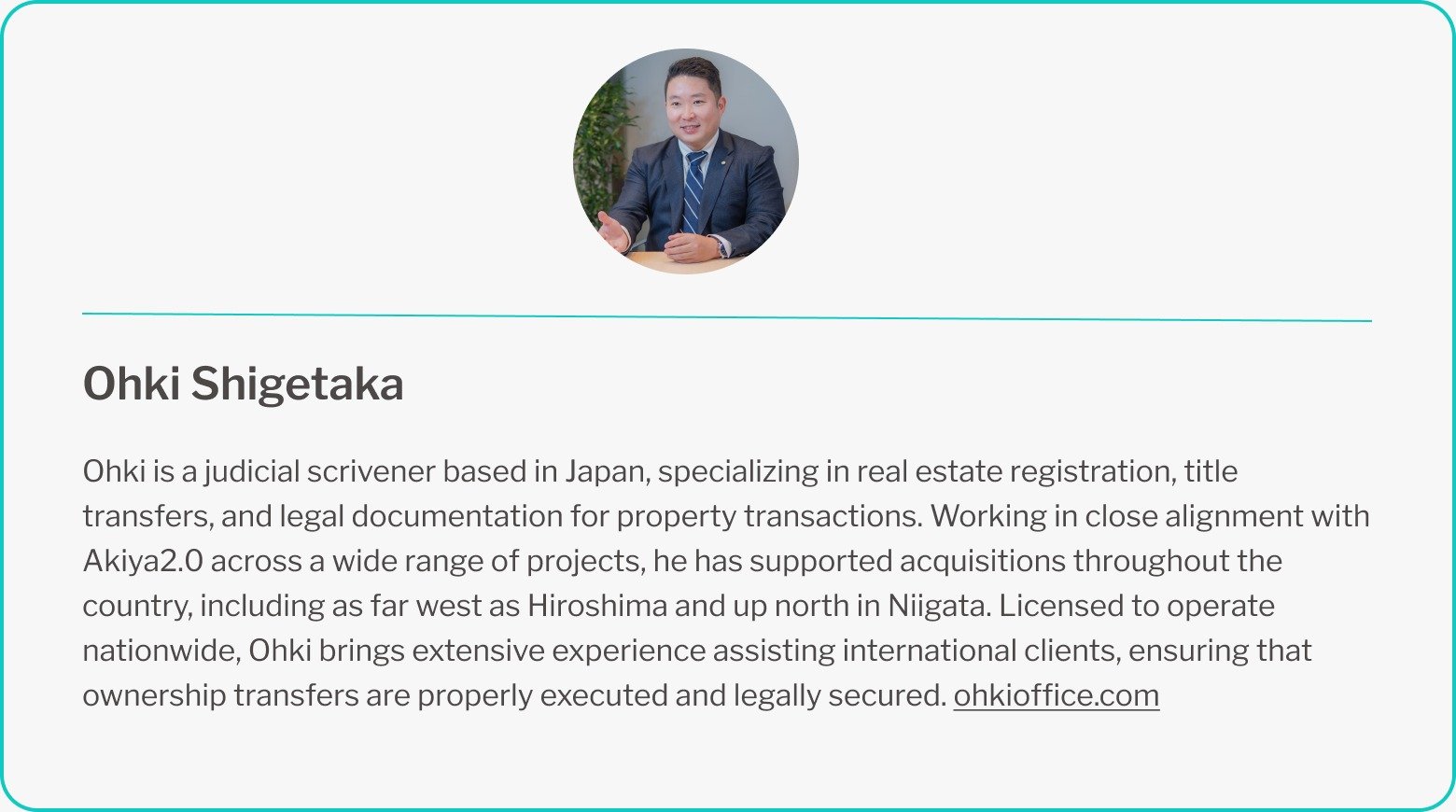
The Role of a Judicial Scrivener in Akiya purchase: An Interview with Ohki Sensei
Japan is one of the very few countries in Asia that permits foreigners to buy and fully own real estate without residency or nationality restrictions. We recently spoke with our long-term partner and trusted judicial scrivener, Ohki Shigetaka, about all things akiya and legal support. From Hiroshima to Niigata, Ohki has many years of expe-rience in supporting property transactions and acquisitions all across Japan, including partnering with us at AKIYA2.0 across a wide range of projects. We’d like to highlight some of his valuable insights on common legal issues faced by foreign buyers, misconceptions people might have about the process of purchasing akiya, and what to expect throughout the legal procedure of purchasing real estate in Japan.
Q: Is it possible for foreigners to purchase and own real estate in Japan? Also, are there any restrictions or points to be aware of when foreigners make a purchase?
A: It is possible for foreigners to purchase and own real estate in Japan.
Restrictions and points to be aware of when purchasing:
1. Some documents, such as affidavits prepared in your home country, cannot be prepared in Japan and can take time to obtain. Therefore, please check with a judicial scrivener or similar professional in advance regarding the necessary documents.
2. Please check if there are any outstanding debts on the property you intend to purchase, such as outstanding loan balances or unpaid maintenance reserve funds.
Q: What role do judicial scriveners play in real estate transactions in Japan?
A: We verify that there are no problems with the real estate transaction itself by reviewing the sales contract, land register, and other documents, and ensure the safety and reliability of the transaction by verifying the identities of the seller, buyer, etc.
While preparing the necessary documents for registration applications, such as ownership transfer and mortgage establishment is certainly part of the job, it also plays a crucial role in protecting the rights of sellers and buyers and preventing legal disputes from occurring.
Q: Could you briefly explain the main legal procedures involved in purchasing real estate in Japan?
A: The procedure is as follows:
1. Checking budget and searching for properties
2. Sales contract and explanation of important matters
Q: When purchasing older houses or vacant properties, in particular, could you please share any legal points or common problems that foreign buyers should be aware of?
A: When purchasing a building, whether new or old, the owner is responsible for its management and repairs, which means that repair costs, management fees, property taxes, etc., will be incurred.
It's important to note that older buildings, in particular, may incur higher maintenance costs than usual due to aging and deterioration.
Furthermore, some properties have restrictions on rebuilding after being demolished, so prior confirmation is necessary.
Additionally, it's necessary to greet your neighbors.
Q: I hear that many vacant houses have been left unattended for many years due to inheritance issues. What kinds of challenges often arise regarding the settlement of ownership when there are multiple heirs?
A: If inheritance registration has not been completed for a long period of time, the number of heirs can increase to several dozen, and if there are heirs who cannot be contacted, it will take time to identify the heirs.
Furthermore, if the investigation reveals that there are no heirs, the ownership will be unknown, which could lead to court involvement and make it difficult to proceed with subsequent transactions.
Q: When purchasing a vacant house or an older home, what are some key points to pay particular attention to when checking the property registry?
A: Since there may be old mortgages or other encumbrances remaining, be sure to thoroughly check for rights other than ownership, and if any are found, complete the procedures to cancel them before purchasing.
Furthermore, since there may be other owners or occupants not listed in the land register (such as those who acquired the property through adverse possession or unregistered transferees), it would be advisable to conduct an on-site investigation.
Q: Could you please offer any advice from a legal scrivener's perspective to foreigners who are purchasing real estate in Japan for the first time?
A: Buying real estate is a very big purchase, and the process cannot proceed unless both the seller and buyer confirm their intention to buy and sell, and all necessary documents are in order. Unexpected problems can also occur, so we recommend that you prepare well in advance.
Q: Based on your experience, could you share any common misconceptions or misunderstandings that foreigners have regarding purchasing real estate in Japan?
A: Some people believe that they can create an affidavit at a Japanese embassy, but in principle, Japanese embassies often cannot create affidavits, and it is necessary to prepare the document in your home country before coming to Japan.
Q: When foreigners are considering purchasing vacant houses or old traditional houses in Japan, are there any points they should definitely check from a legal standpoint?
A: Please carefully check whether there are any security interests other than ownership rights attached to the property. Also, if there is a discrepancy between the land area or building floor area and the actual property, it may lead to problems.
It's a good idea to check for any neighborhood disputes or outstanding tax payments before purchasing.
Buying property can feel like a daunting and overwhelming ordeal without the right guidance. Speaking with Ohki offered a rare, candid look into the legal side of property ownership in Japan, as his insights on navigating document complexities, understanding the legal procedures, and common misconceptions remind us that due diligence is essential. With the right professionals in your corner, what looks like a complicated marathon becomes a manageable and even exciting process. At AKIYA2.0, working alongside trusted specialists like Ohki is central to how we support our clients, not just in finding the right property, but also in making sure the path to ownership is clear, legal, and stress-free.
If you're considering taking the leap into Japanese property ownership, we're here to guide you every step of the way.
Ready to start your journey? Explore our listings or get in touch with the AKIYA2.0 team today.