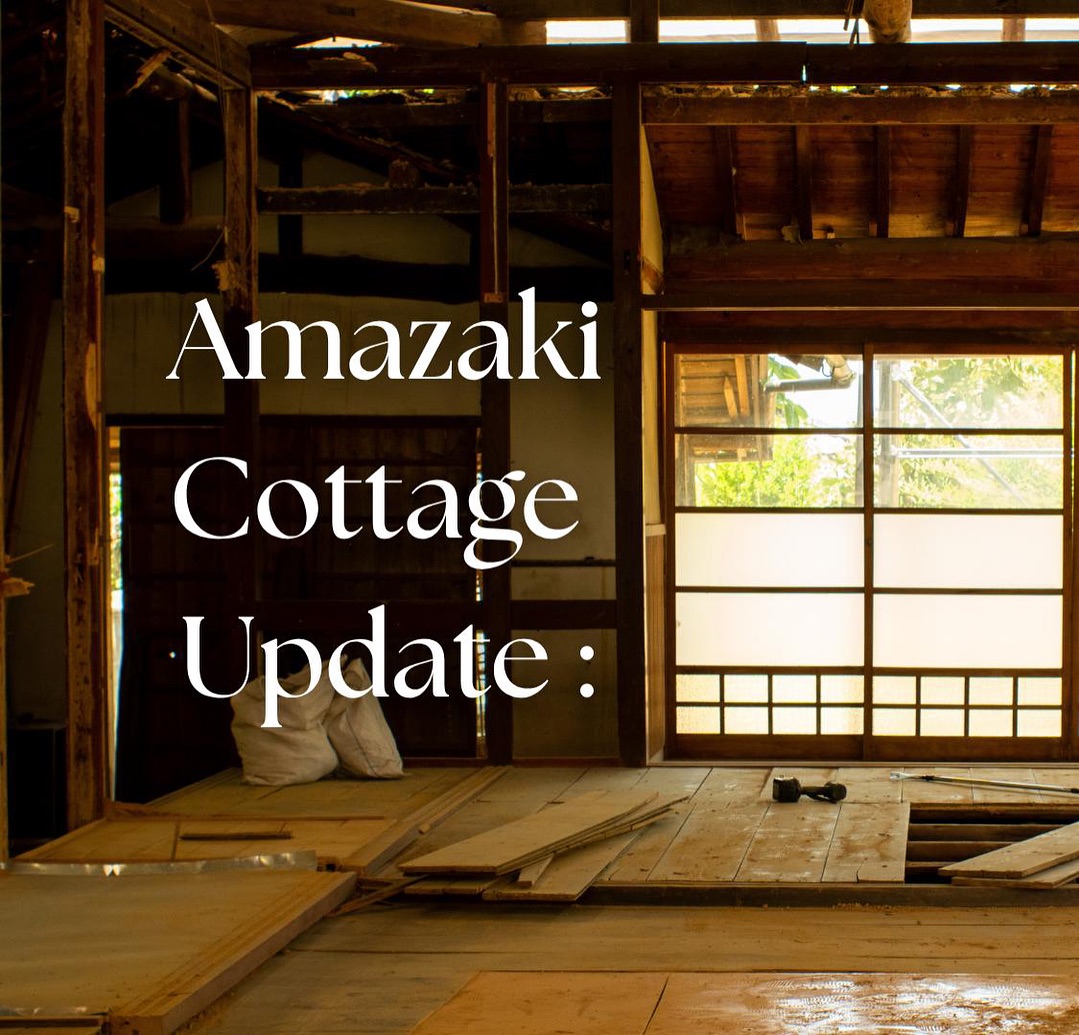
Amazaki Cottage Update
The next step in the renovation for our Amazaki cottage is to seal the roof and prepare the earthen foundations.
After removing all the antique roofing tiles ("Kawara") and underlying clay, our builders, Team Yasaki, have installed waterproof sheeting over the roof structure. This allows the house ceiling area to breathe under the refitted roofing tiles while keeping the wooden structure safe from rainwater - obviously not traditional, but a long overdue upgrade that will only help our kominka last a further century. Once the tiles are back on, the original aesthetics of the house will be all you see. Most of the homes we are renovating need a roof replacement due to our focus on traditional minka-style homes, and the combination of waterproofing + antique tile reuse is one of the many SOPs that AKIYA2.0 has established.
Team Yasaki has also made a start on the interior earthen foundations. Much like the roof, the floors of a traditional Japanese wooden house need to either "breathe" to allow the natural ventilation and drying out of wooden members. The alternative used in modern Japanese construction is an entirely sealed off concrete base - which works for modern buildings but is not compatible with kominka construction. Using concrete for a traditional home is a worse-case scenario only if dampness exceeds allowable levels. After close inspection revealed that moisture level is not an issue at this site, we decided to stay with earth foundations and thus allow the soil to naturally respond to ambient moisture levels.
On some houses we like to leave the Obiki (major floor joists) and sub-joists in place, but for this cottage, there is a large hole in one area under the floor, where the family used to store their sweet potatoes in the winter! It is always interesting to see where ancient wisdom led to certain design choices (function over form!) that shape architecture and living. Incidentally, we also found in this cavity almost 50+ more tiles, saved for a rainy day. I wonder if the original owners who put the tiles there would have imagined that we would dig them out in 2025 - and use them!
After levelling the floor, we decided to gut the under-flooring and rebuild with new heavy sugi joists supported by piles placed on cement blocks. This will be done to modern specifications to ensure the safety of the building by today's standards.