Are Abandoned Houses in Japan Almost Free?
Japan is home to a growing number of akiya, now around 9 million houses left empty as the country's population ages and shrinks, particularly across its rural regions. For an introduction to the topic, see our complete beginner's guide to akiya. While akiya are frequently associated with very low prices, or almost free, the true cost of buying an akiya extends well beyond the initial purchase. From contracting to renovation to property maintenance and possibly commercialization, owning an akiya involves costs at every stage of the process. This guide outlines the full cost of an akiya in Japan, from purchase through renovation, ongoing ownership, and beyond.
What does it cost to buy an akiya?
The purchase price is often the smallest line item at the beginning of your akiya journey and is certainly not the whole picture. Once you factor in the real estate agent's commission, commonly 3% of the purchase price plus ¥60,000, plus consumption tax for properties above ¥4 million, along with a real estate acquisition tax (typically 3-4% of the property's assessed value) and registration fees, the true buying cost usually lands well above the advertised price and can even exceed the original purchase price of the property itself for a very cheap akiya.
A professional inspection is worth budgeting for here too, even though it's optional; older akiya can hide structural, termite, or foundation issues that aren't visible in listing photos, and catching these before closing is far cheaper than discovering them after.
If you're buying from overseas, add a few more line items: a power of attorney, a Japan-based contact for registration, and a FEFTA report filed with the Ministry of Finance within 20 days of purchase, required for most non-resident buyers as of 2026.
This is exactly the stage where AKIYA2.0's Buy service is designed to help, guiding you through property selection, fee negotiation, and paperwork so nothing gets missed along the way.
And so what does an akiya cost? In rural areas, akiya are typically about the same price as surrounding bare land, meaning the house has little or no value. You can pick up a rural 300m2 property with 120m2 house from approximately JPY1.5MM-JPY10MM (US$9,400-US$63,000). In the cities, these numbers go up 3x to 4x, depending on the size of the city and where the property is located (usually within 45-60 minutes commute of the city center).
In the end it comes down to what you want from your property and how long each year you plan to use it. From our experience, Japan offers some of the cheapest and most scenic rural and waterfront properties in the world - making the ownership experience worth the investment.
What does it cost to renovate an akiya?
This is usually the biggest wildcard in the whole process. As a general benchmark, the higher your purchase price and thus the better condition and newness of the home, you are going to have far less renovation costs, while at the low end you may have to completely rebuild the home. So in general we tell clients that for a 100m2 - 130m2 one-story 80-year old rural timber bungalow bought at the low end of the market, your buy and rebuild cost will probably be around JPY15MM-JPY24MM (US$94,000-US$150,000), depending on the level of finish. Indeed, in our own projects, we target an average JPY20MM spend.
If your property is in much better shape, then you can halve these numbers. Note that on a full renovation of an older property, contractors do tend to underestimate costs, so we advise clients to expect overruns of 130-150% of the initial estimate once the team gets a closer look at the property's real condition. Furthermore, building materials are increasing in price monthly as the yen plummets, and of course traditional kominka-style homes need specialized (and pricier) craftsmanship to preserve original wood joinery, roofing, and layout.
Permits are also easy to underestimate. Minor interior work usually doesn't require one, but structural changes, additions, or a change of use typically do, and as of 2025, a change to Japan's Building Standard Law now requires all two-story wooden buildings to obtain a building permit regardless of size, adding extra cost and paperwork many older-property buyers don't expect going in.
To make these costs more predictable, AKIYA2.0's Renovate service structures its pricing by pricing through contractors (competitive bid process) and adding project management fees of 5% of building fees for new builds, and 10% of fees for renovations, with earlier planning stages (like a location review or a client design brief) priced separately starting from ¥70,000. This upfront pricing lets you avoid "hidden cost" that can catch many akiya buyers off guard.
What does it cost to manage an akiya after buying it?
Beyond the property itself, every owner should budget for annual property tax (roughly 1.4% of the property's assessed value in most areas), fire and disaster insurance, utilities, and routine upkeep, none of which stop once the sale closes.
For non-resident owners, this stage gets more complicated fast: registering utilities, filing local tax paperwork, receiving mail, and handling repairs all typically require being physically present in Japan, or hiring someone who is. AKIYA2.0's Manage service is priced specifically around this gap: a one-time setup fee (¥85,000 for essential account setup and utilities liaison, or ¥105,000 for expanded support including insurance setup and administrative management), plus an ongoing monthly fee (¥15,000-20,000) covering bill payments and reporting. Optional add-ons, like scheduled property inspections and repair coordination, start from ¥15,000.
For owners having a property that will sit vacant for stretches of time, a common occurrence with rural akiya, this ongoing management cost is worth factoring into your total budget from day one. Do not get let your property non-compliance spiral out of control through negligence. The legal fees and penalties can be onerous, not to mention the ill-will created in the community with an unmanaged house and land.
What taxes do homeowners pay in Japan?
Taxes on an akiya show up at multiple points across ownership, and it's easy to lose track of them when they're scattered across different stages.
At purchase: a real estate acquisition tax (typically 3-4% of the property's assessed value), a one-time tax paid shortly after buying, covered in the Buy section above.
Every year after: an annual property tax (roughly 1.4% of assessed value in most areas), which continues for as long as you own the property, covered in the Manage section above.
If renting the property out: rental income earned from an akiya is generally subject to Japanese income tax, even for non-resident owners, and will involve additional reporting depending on how the property is operated, relevant if you move into the Commercialize stage below.
Can commercializing an akiya (renting it out) offset these costs?
For owners open to renting out their property, short-term rental income can meaningfully offset the ongoing costs covered above, though it comes with its own setup and running costs to factor in.
Before anything else, most operators need a Minpaku license, a licensing step that catches many first-time owners off guard. This is an entirely separate legal process from the purchase itself. AKIYA2.0's Commercialize service breaks costs into two stages: a one-time pre-launch setup (¥155,000 for basic platform registration and listing setup, or ¥500,000 for an advanced package including pricing strategy and listing optimization), plus ongoing monthly management (¥77,500 for basic guest communication and financial reporting, or ¥205,000 for advanced service including marketing and periodic housekeeping). Individual guest stays also carry a turnover fee (from ¥7,500 per stay) covering post-guest cleaning and restocking.
Whether this stage makes financial sense depends heavily on location, property type, and how much hands-on management the owner wants, but for buyers weighing the full cost picture, it's worth factoring in as a potential offset, not just another expense. If your property is in a popular rural destination you can probably expect to gross around JPY2MM-JPY4MM annually, while in a major city, up to 50% more than this. As you can see, this income can quickly disappear in fees, so you do need to do your economic planning carefully or have someone like our team run a commercial scenario for you. Most rural areas are seasonal destinations, so the 180 day minpaku licence is about right for an average home.
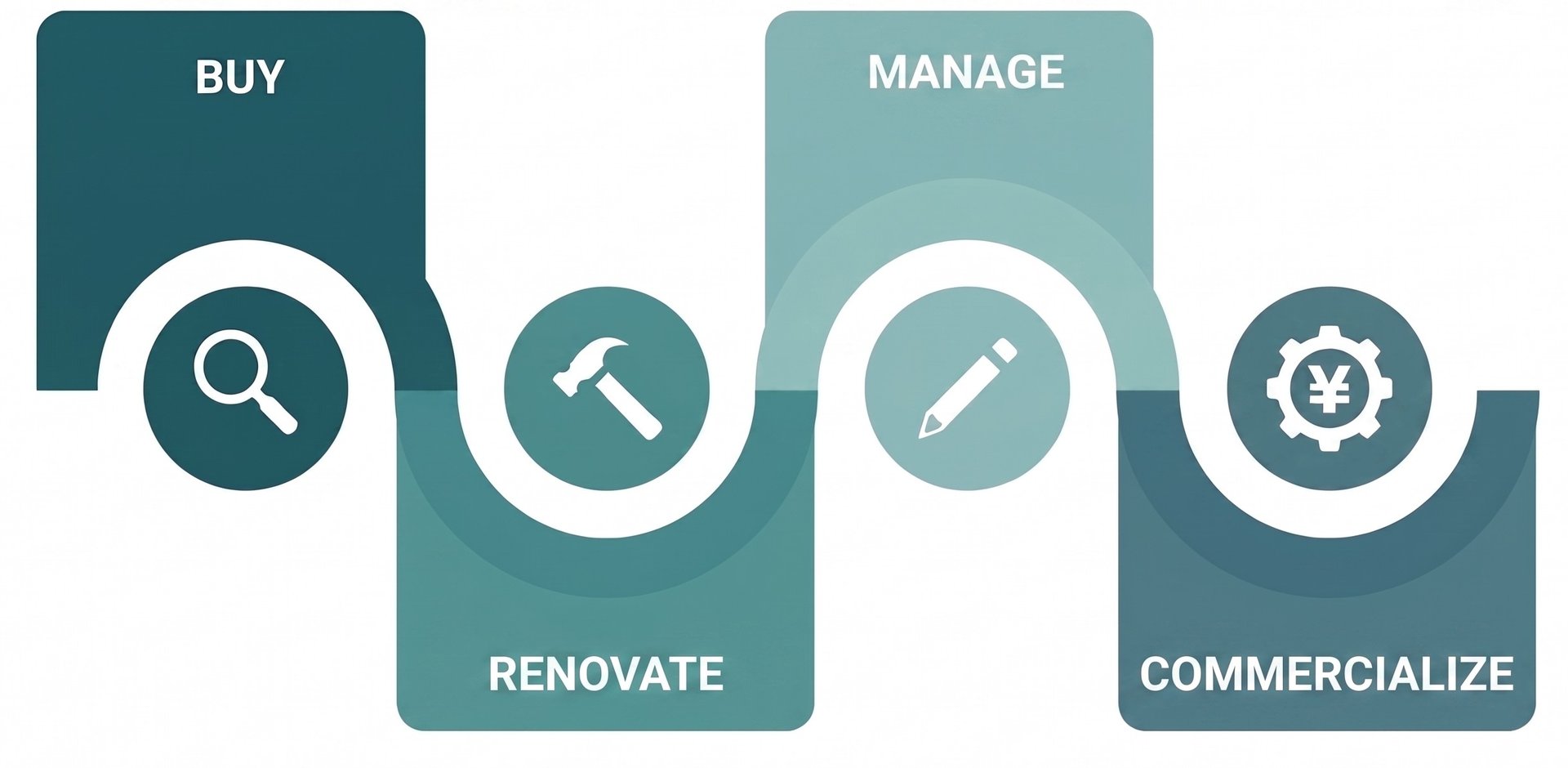
Buying an akiya is rarely just the purchase price. Between agent fees and acquisition tax at purchase, renovation and permits to make the property livable, ongoing property tax and management once you own it, and for some owners, commercialization costs on top of that, the true cost of an akiya unfolds in stages, not all at once. Understanding this full lifecycle before you buy is the difference between an exciting investment and an expensive surprise. AKIYA2.0 supports every one of these stages, so you don't have to piece the costs together on your own.